The Family Factor Why the Future of Adventure Isn’t Solo
Kashmir Off Road
For a long time, adventure was measured in familiar terms: how far you went, how difficult the terrain was, and how much you were willing to endure. That definition is beginning to shift. Travelling alone keeps decision-making simple. You choose how long to drive, whether to attempt a difficult stretch, whether the weather allows you to continue, or whether it’s time to turn back. The consequences are largely your own. Travelling as a family changes that equation entirely, you start measuring a journey not just by the road ahead, but by the people sitting beside you.
Our recent trip to Marwah Valley, in Jammu and Kashmir’s Kishtwar district, was a reminder of exactly that.
Into the Unknown, Slowly Marwah Valley remains remarkably isolated. While many travellers make their way to the Warwan Valley, relatively few continue on to Marwah itself. We carried enough food for the entire journey, because there are long stretches where you cannot assume you’ll find what you need along the way.


The route took us through shifting weather, narrow mountain roads, sections damaged by rain and cloudbursts, fog, water crossings, and an almost complete absence of traffic. But what stays with me isn’t the road, it’s how we travelled it.
When the weather closed in, we slowed down. When visibility dropped, we stopped. Sometimes we simply got out of the vehicle to stand in the rain and watch clouds move through the mountains. We had planned certain stops along the way, but we soon realised the best ones were rarely the ones we’d planned: a beautiful patch beside the road, a river bend, a group of nomads moving towards their winter homes, a small Gujjar-run tea stall where we sat with nun chai with sattu.
The journey began to set its own rhythm. Perhaps one of the first lessons family travel teaches you is that you don’t always have to keep moving.
Judgement Over Grit Traditional adventure culture carries a certain kind of masculinity that celebrates pushing through, go further, drive harder, cross the obstacle, never turn back. But when you’re travelling with your family, knowing when to slow down matters just as much as knowing how to keep going.Farah has always been central to that decision-making for us. She plans our food, contributes to the photography and filming, speaks with the people we meet, and particularly in difficult conditions, has an instinct for when we should stop and when we should push on. I’ve learned to trust that instinct completely. Adventure, in that sense, stops being purely about physical capability. It becomes a question of judgement. And that, perhaps, is a more mature way of looking at it.
The same logic applies to the vehicle. On journeys like this, capability matters, but it’s no longer the first thing we think about. After hours on the road, getting in and out repeatedly to shoot photographs and film, reaching for equipment, hauling food and gear for days at a stretch, comfort becomes the real priority. The Scorpio-N gives us the confidence to take on rough, wet roads without constantly second-guessing the vehicle, and its 4x4 capability is there when we need it. But just as important is that we don’t end each day exhausted simply because the road was rough. The automatic transmission helps. The seats matter. The space matters. Being able to carry everything we need, matters.
None of this makes for particularly dramatic photographs. But it’s exactly what determines whether a family wants to keep travelling.
Salman’s Journey At sixteen, Salman is no longer just the child in the back seat. He photographs whatever catches his eye, films independently, and operates the drone, sometimes on our instruction, sometimes entirely on his own judgement of what’s worth recording. He has a natural inclination towards art and spends his spare time sketching.
Yet on a journey through Marwah, he remains exactly what he is: a sixteen-year-old who talks about school, basketball, his friends, and very often sneakers. He also talks about bringing his friends along on our expeditions, because they keep asking him when they can come too. That, perhaps, is the real measure of whether a child is enjoying adventure, not whether he can handle an off-road section, but whether he wants to come back for more.
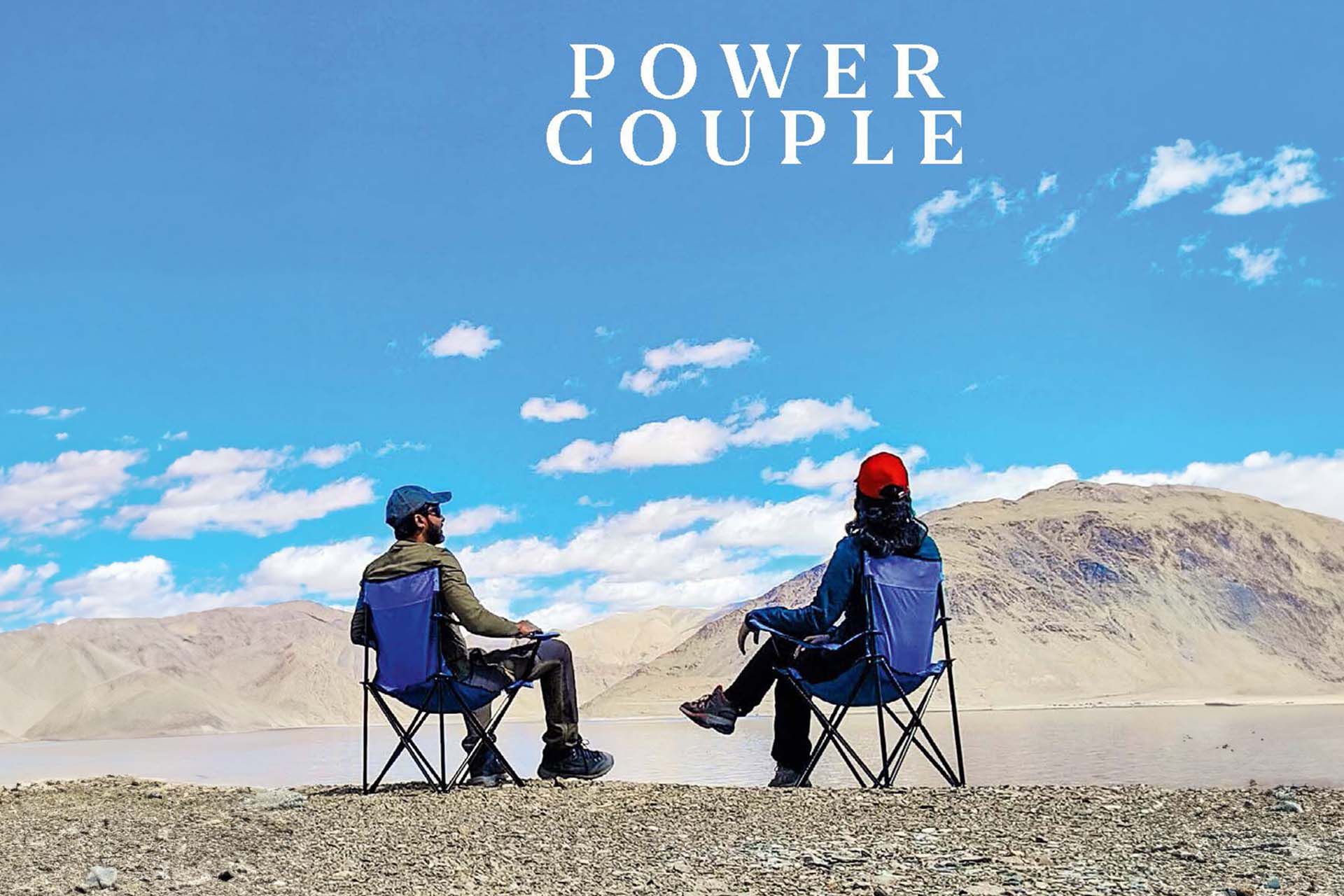
At one point, beside the Marusudar River, we stopped simply because we’d found a beautiful place. We put up our canopy, brought out the chairs, made lunch, and stayed for hours. Salman helped cook. We walked around. We skipped stones. We talked. There was no objective left to achieve, no pass to cross, no village to reach, no photograph we absolutely needed. We were simply together. Those, I think, are the moments that matter most.
More Than a Landscape We often think of family holidays as being about taking children somewhere. Perhaps that’s the wrong way to think about it. The real value may lie in giving them time and space to experience something without constantly telling them what that experience should mean.
In Hanzal village, Salman became fascinated by an old tree believed to be more than three hundred years old beside which the local community has built a small temple. He had questions about the Kashmiri Pandit community that has lived there for generations. These aren’t lessons easily taught from a classroom; a landscape becomes more than a landscape when you meet the people who live within it. The same held true when we encountered nomadic families moving towards the warmer plains of Jammu for winter, and watched sheep being sheared by hand with traditional scissors, a practice that survives simply because it remains part of everyday life. For Salman, these weren’t curated cultural experiences; they were things we encountered because we were travelling slowly enough to notice them. Children, I’ve come to believe, don’t necessarily need more extreme experiences. They need richer ones. Perhaps the greatest thing our journeys have given Salman is a relationship with nature. When there’s a long gap between trips, he asks when we’re going again. And when we are travelling, something interesting happens, he relaxes. On this journey, he started singing loudly in the car, completely out of tune, and then told us that on these trips he felt he could do things without being conscious of himself. That stayed with me. Because maybe that’s what adventure can offer a child: not just confidence in dealing with mountains, rivers, or difficult roads, but confidence in being themselves.
Redefining Who Adventure Belongs To The family factor also changes the idea of who an adventure belongs to. It cannot simply be the person behind the wheel. Farah is not a passenger on our journeys, she helps decide when we stop, what we carry, where we eat, and who we speak to. Salman isn’t a passenger either; he’s becoming an observer, photographer, drone operator, and storyteller in his own right. The roles are fluid. Perhaps that’s what the future of adventure should look like: not one person leading while everyone else follows, but a family contributing different forms of knowledge, instinct, and curiosity.
Choosing Not to Rush Our final day in Marwah summed this up better than anything else. We had planned to visit Tatta Pani, the hot-water springs. We could have gone, the vehicle could have taken us there without difficulty. But we decided not to. Not because the road was impossible, and not because we couldn’t have made it. We simply didn’t want to rush. We wanted to drive back slowly and take in the places we’d passed too quickly on the way in. That decision would once have felt like giving something up. Instead, it felt like gaining something because when the destination becomes less important, the road opens up. You start noticing the narrow trail you might otherwise have ignored. You stop beside a river. You talk to a nomad. You watch the clouds. You discover a village. You begin to understand that exploration isn’t necessarily about reaching somewhere nobody has reached before. Sometimes, it’s about seeing something familiar differently.
Perhaps that’s where the future of adventure truly lies, not in making family travel more extreme, and not in proving how much terrain a vehicle or a person can conquer, but in creating journeys where everyone has a place in the experience. Where a mother’s instinct matters. Where a child’s curiosity matters. Where turning around isn’t failure, and stopping isn’t wasted time. Where comfort isn’t weakness. And where the greatest achievement at the end of a journey isn’t how far you travelled, but how much of the world and each other you noticed along the way.
Maybe the future of adventure isn’t about raising children who are comfortable in difficult terrain. Maybe it’s about raising children who are comfortable in their own skin.